
Learning from "Angels and Demons"
It's commonly recognized that many popular books aren't good, and are in fact quite bad. As writers we wonder, what is it about these books that draws peoples attention (and money), and can we capture it in books that are also actually good?
Dan Brown is a name of both derision and, if we're honest, envy among writers. He is famous for both bad-to-mid writing and for selling books like crazy. Whatever generates his success, it must be mostly reader engagement and excitement. In my project to figure out how to engineer engaging and exciting prose, he seemed like a good subject for study.
I chose Angels and Demons because, uh, it was 50 cents in the used book sale at the library. Later, a couple friends told me it was one of the better of Brown's books, so there were worse choices. (For instance, the other Dan Brown book at the library, Digital Fortress. I could tell from the cover copy that it was about cryptography, and that, as someone with a passing knowledge of real cryptography, reading it would give me neurological damage.) It wasn't exactly the society-wide blockbuster of The Da Vinci Code, but it seemed like a solid-enough case study. I set a few hours aside and dove in.
The Reading
Let's get my overall impressions of the book's quality out of the way. Note that this is a free-fire zone for spoilers.
At a sentence level, I found it flows just well enough to keep going.
I certainly spotted a few of the clunky sentences and clumsy metaphors for which Brown is infamous, but
I didn't find it distractingly bad.
Honestly I'm not that big a snob for perfect, beautiful sentences in my fiction.
If the concepts are sufficiently interesting, I'll wade through a bit of mud to learn about them.
(That's not to say I'm oblivious to the difference.
I recently started reading a John Le Carré novel and the difference in quality is palpable.
Le Carré's prose is delicious.
Brown's is adequate like a cheap frozen pizza.)
Anyway, I suspect Brown earned his reputation for awful prose from other books, because this was alright.
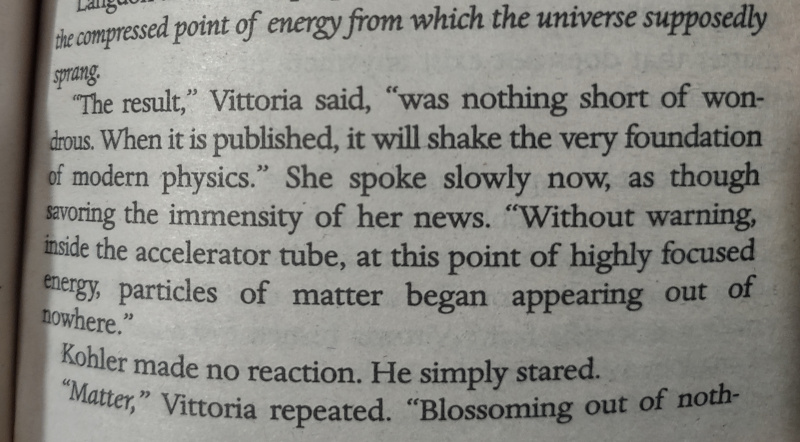
Naturally the "science" throughout the book is nonsense. The book starts with a page labeled "Fact" that consists entirely of half-truth and sensationalism about anti-matter. A bit more surprisingly for such a supposedly history-focused author, the science history is garbage. The administrator of CERN, Maximilian Kohler, is noted as a knowledgeable and devoted scientist (Dan Brown's vision of a devoted scientist, anyway; I find him cringe-inducing). He is portrayed as being shocked at the existence of antimatter, presumably after the year 2000, when the book was published. LHC did not actually begin operations until 2008, so Brown must imagine these events happening, at the earliest, soon after the time this book was published. Antimatter was mathematically predicted in 1928 and experimentally verified in 1932.
Even more embarrassing is the way Kohler accepts without question the implication that the creation of particle-antiparticle pairs bears in any way on the creation story of Genesis. If Brown just wanted a loose antimatter bomb, it would have been reasonable scifi to say that the story's physicists came up with a more efficient way of generating and capturing antimatter. But for his plot to mean anything, the creation of anti-matter in a lab has to imply that the Genesis story is scientifically plausible. This is nonsense. Creating antimatter in a particle accelerator still preserves mass-energy, which, since we know from Einstein that mass and energy are two forms of the same thing, is the actual quantity whose conservation matters. Using the huge energy expenditure of a particle accelerator to create anti-matter therefore implies nothing about creation from actual nothingness. Meanwhile, a God in the process of creating physics itself is not bound by what happens in a particle accelerator; he decides what happens there.
Even more bafflingly, Brown, through Kohler, later acknowledges the proven existence of antimatter prior to this story.
I wonder if this was a sop to an early reader pointing out how old the knowledge of anti-matter is, acknowledging the truth superficially but not admitting that it renders the theme void.
This could have been prevented with a
Wikipedia-level understanding
of antimatter and its discovery.
The story attempts to use the ideas of antimatter and creation to comment on the tension between science and religion, but does not have the intellectual caliber to pull it off.
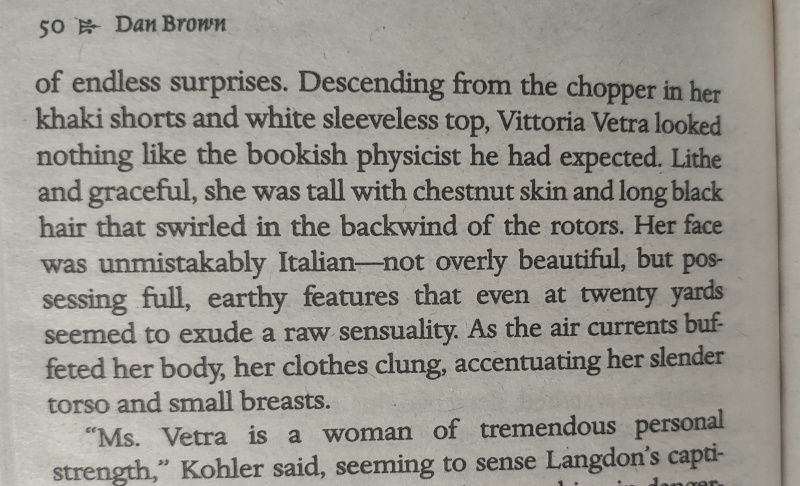
The characters often don't quite make sense. Many are only token deviations from cliched archetypes. The narrative stops just short of congratulating itself for not giving the female lead big boobs. Maximilian Kohler is quite a tiresome stereotype of an emotionless scientist, besides being totally ignorant of the actual science CERN does. Characters occasionally act "on instinct" when plot demands that they do something silly. At other times their actions are simply nonsense.
None of this stopped me from reading the book in a single sitting.
Brown quickly, and often deftly, builds suspense and mystery, starting from the first pages. It's ultimately not surprising given his reputation, but I was impressed despite myself. So, how did this mess of a book get its hooks in me so quickly?
The Breakdown
What follows is a summary of the first few critical pages of the book, when I was still deciding if I was going to have to slog or rip through the book.
The first page of narrative, after the ill-named "Facts" page, is a half-page prologue. There's a little bit of "mystery" about exactly what's happening, partly because the narration is shy about details that would be obvious to the characters in the scene. But it's plain enough that a "Physicist Leonardo Vetra" is being tortured, via burning, by a mysterious figure for a password that doesn't exist. "His only solace was in knowing that his attacker would never obtain what he had come for". But he is disabused of this by a blade hovering "Carefully. Surgically." near his face. All we know at this point is that there's something worth torturing a physicist to death over.
The first paragraphs of Chapter 1 depict Langdon climbing the great pyramid of Giza after his young wife. She is replaced with a gross old man and Langdon wakes up. No points for subtlety here, but for what it's worth I am already wondering why someone would have this dream. (Tough nuggets. It basically doesn't come up again until an equally pointless callback in the denouement. Perhaps this is a reference to books that I haven't read.) Nonetheless, it evokes the ancient world, narrowing down the topic.
It turns out the reason, Langdon our protagonist, is waking up is that the phone is ringing at 5 AM. Obviously this conveys urgency, with a reason as yet unknown (though the reader, having just seen the prologue, can make a reasonable and correct guess). We can also have some sympathy for Langdon's displeasure at being woken up this way.
The urgency is reinforced as The caller says "I must see you immediately". He self-identifies as a "discrete particle physicist". (I've never heard a real particle physicist describe themselves that way, and the first page of Google results for that phrase consists of references to this book. Nevertheless, moving on.) Langdon expresses surprise that a particle physicist is calling him, since he's a "symbologist" (based on casual research this does not appear to be a real academic field. Academic references to "symbology" specifically refer to symbols on maps. The actual field Langdon studies seems to be somewhere between archaeology and semiotics.) The caller confirms that he is a particle physicist looking for Robert Langdon, world renowned symbologist, and further that he can't discuss the urgent matter over the phone. (A fax over the same phone lines will turn out to be fine though.)
We're a couple hundred words in and already have mysteries. Why is a particle physicist calling a symbologist? How do these fields connect, and why is it urgent?
Naturally, Langdon assumes this is a crank call and hangs up. Academics are indeed often accosted by cranks, so it's a reasonable, or at least realistic, response. Thus the reader is presented with a mundane hypothesis to explain what Langdon has experienced so far. This creates a bit of a false lull in the tension, where we know as readers that that can't possibly be the real answer, but the POV character has no reason to suspect otherwise. In the ensuing silence we get about a page of exposition about Langdon's life and background, as he mourns his inability to go back to sleep.
Then the fax machine rings, and Langdon receives an image of an apparently Illuminati-related symbol literally branded on a human corpse. This is of course Leonardo Vetra, whom we saw in the prologue. Langdon thinks it's very significant and surprising that the symbol has 180-degree rotational symmetry, and manually turns the fax printout upside down to confirm. We read a fair bit about his physiological symptoms of shock, then he answers the phone when it rings again.
The caller reveals that there was a murder at his lab (no reason given why he couldn't mention this before), and the picture was of the victim. Langdon is shocked and intrigued by the symbol, "possibly representing the epigraphical find of the century". (He will later belabor how close to difficult it is to create such a symmetric symbol, nearly impossible. This is very hard to take considering that there are two of them in the book already, including one of the book's title, with more to come. Very deep magic was required to create these, clearly. I'll admit there's one that's actually quite neat toward the end of the book.)
Langdon is particularly shocked and intrigued by the idea that Illuminati are alive and active. I believe the narrative is counting on the reader having heard of the Illuminati through cultural osmosis, knowing that they were, emphasis on the past tense, a secret society somewhere around the time of the Renaissance. The question about why the urgency is at least partly answered, replaced by the (hopefully) even more pressing and interesting question of "are the Illuminati genuinely involved, and if so why?" At the end of chapter 2, Langdon has agreed to fly to CERN to investigate.
Chapter 3 is just over half a page in another POV, "the killer" speaking to "the man in charge". They mutter darkly and obliquely, with Italian accents, about murder and theft and "serving the brotherhood". The "man in charge" asks, "And there will be no doubt who is responsible?". Clearly perceived attribution is important here, "The killer" drops a big "electronic device" on the table, presumably the thing he killed Vetra to get. The scene ends with "the man in charge" saying "tonight we change the world", which is a bold claim with a tight timeline.
No points for subtlety here. Both characters have a clear idea of what's going on, and what will happen, but the narrative only gives a superficial description of the physical events. This is almost cheating as far as building mystery, but it mostly works. The scene drops enough information to hint that the Illuminati are, in fact, alive, active, and committing crimes, without actually proving much about the nature of whatever agency is acting. Both people in the room talk like the Illuminati exist, but the story leaves room for the possibility that at least one of them is deceived or mistaken.
At this point in the story, I was already on a trajectory to finish the book despite its obvious flaws.
The Lessons?
The real question for us writers: How would we engineer this opening given the premise?
Oh right, the premise. Major spoiler time: Leonardo Vetra and his daughter Vittoria have isolated a significant amount of antimatter, which "the killer" has stolen. The "man in charge", who is the late Pope's camerlengo (roughly his assistant), has planted it deep under the Vatican in a secret location. The magnetic bottle will release the antimatter, causing an enormous explosion, 24 hours after being stolen. The "killer" has been instructed to murder four cardinals dramatically and publicly in a way that hearkens back to the Illuminati, which he indeed thinks he is serving. It's actually a ploy by the camerlengo to somehow call public attention back to God, who he feels has been inappropriately eclipsed by Science, and also take revenge on the Pope who betrayed God by having a child out of wedlock or something. He is also going to use the chaos to fake a miracle and become Pope. Langdon and Vittoria Vetra, Leonardo's adopted daughter, sort this out just in time to save the Vatican from annihilation. Got it? It's fine. Don't worry about it.
One of the standard ways to build suspense is to threaten a character with harm. The first pages are pretty early for this to work. We don't know the POV character at all. Perhaps that's why Brown doesn't really attempt it. There's no direct threat to anyone (still alive) at this point in the story, much less enough to drag me through a whole novel.
There's a sense of urgency early on, with the midnight phone calls, and soon after an implausibly fast airplane, but this doesn't do much to pull me through the story without stakes. My sympathy for Langdon being woken up at 5am is the strongest force that could get me to care about the outcomes for anyone in this story, and that's still pretty mild. We've been told by Chapter 3 that whatever it is, will happen "tonight", but I don't yet know if I should take that seriously. A rush to go nowhere in particular does not draw me in, and that's all urgency on its own provides.
As I hinted earlier, it was curiosity that pulled me through the book. That's not the only valid form of tension or suspense, but it definitely works on me. Part of my curiosity at this point, because I came in with a skeptical perspective, was wondering whether this was the kind of book where the Illuminati are real, or whether that has to be a fakeout. But I also wanted to know, in the way a less cynical reader would, the explanation behind all the events in the story so far.
There some obvious moves to build mystery, like characters refusing to tell all they know. Obviously what they say is a clue, and we're left to wonder about what they know but don't say. This can work, but I think it's one of the things Brown executes clumsily in this opener. The things Kohler withholds information about make very little sense for his character and so feel contrived.
One of the things I always wonder, when reading about odd combinations of events, is exactly why it reads as mysterious. Why do these "why" questions work better than the morass of "why" questions one asks when reading something confusing? All I can figure is that there has to be something about the exact mix of knowns and unknowns. Which is interesting, because the true knowns are actually pretty scarce. For example, the average reader doesn't know anything about what a symbologist or particle physicist actually does. We have enough of an idea (or at least a fantasy) of the life of a scientist to see that calling strangers in the middle of the night is not part of their normal job. But knowing that it's odd doesn't tell us much else, especially not why.
Brown creates a network of clues, only loosely connected. They invite possibilities without narrowing down the options very much. Emotionally loaded or evocative concepts are raised, like the Illuminati, the Vatican, murder, the "highly volatile substance" of antimatter, and so on, with very little about how they are related.
We can tell there are a lot of possibilities. The space of all possible relationships, ways one element could affect the other and so forth, is very wide. At the same time, options that don't touch any of the clues we've seen at all are mostly ruled out (it's not the CIA, it's not a bioweapon, etc), which gives us a little bit to work with. It prompts the mind to race, trying different ways of fitting them together like potsherds, but we know that without more clues we won't actually be able to find the answer. And that, I believe, is the exact feeling you want to create in the reader.
The most concrete technique for quickly building mystery and curiosity that I can extract from this exercise is: Mention or evoke some kind of emotionally resonant objects or actors pertinent to the mystery, imply that they relate to each other or have some other role in the mystery, but give only the slightest hints as to how. Critically, this is possible without sentences full of delicately phrased ambiguity. The plainly stated facts of the story can be enough, as they (mostly) are in this case.
Obviously applying that formula on its own is likely to be Bad. It's not the only thing Brown is doing either in these pages, either. Our goal here is to take the useful parts of the work we're studying and make them into better art. One way we could improve on Brown's opening is to have the elements of the mystery introduced by less contrived events, and particularly by dialogue that makes more sense for the characters and their motives.
That's the best I can do as far as a thesis, at least for now. Certainly there's a lot more technique to be mined just from this book, to say nothing of better ones. If you have questions or ideas, talk to me on Bluesky at @laminarnotes.com!
I'll be back with more someday, though my next post will likely be a technical one. I'm working on some changes that will bring Laminar Notes dramatically closer to my long term vision, and those will definitely be worth writing about. See you then!